Five Aircraft, One Formation: What AutoFlight's Record Says About Lift-and-Cruise Powertrains
AutoFlight says it flew five unmanned eVTOLs in a single autonomous formation — one five-tonne V5000 leading four two-tonne aircraft for 47 minutes and more than 133 km. For propulsion buyers, the interesting part is not the formation. It is the duty cycle.
What actually flew
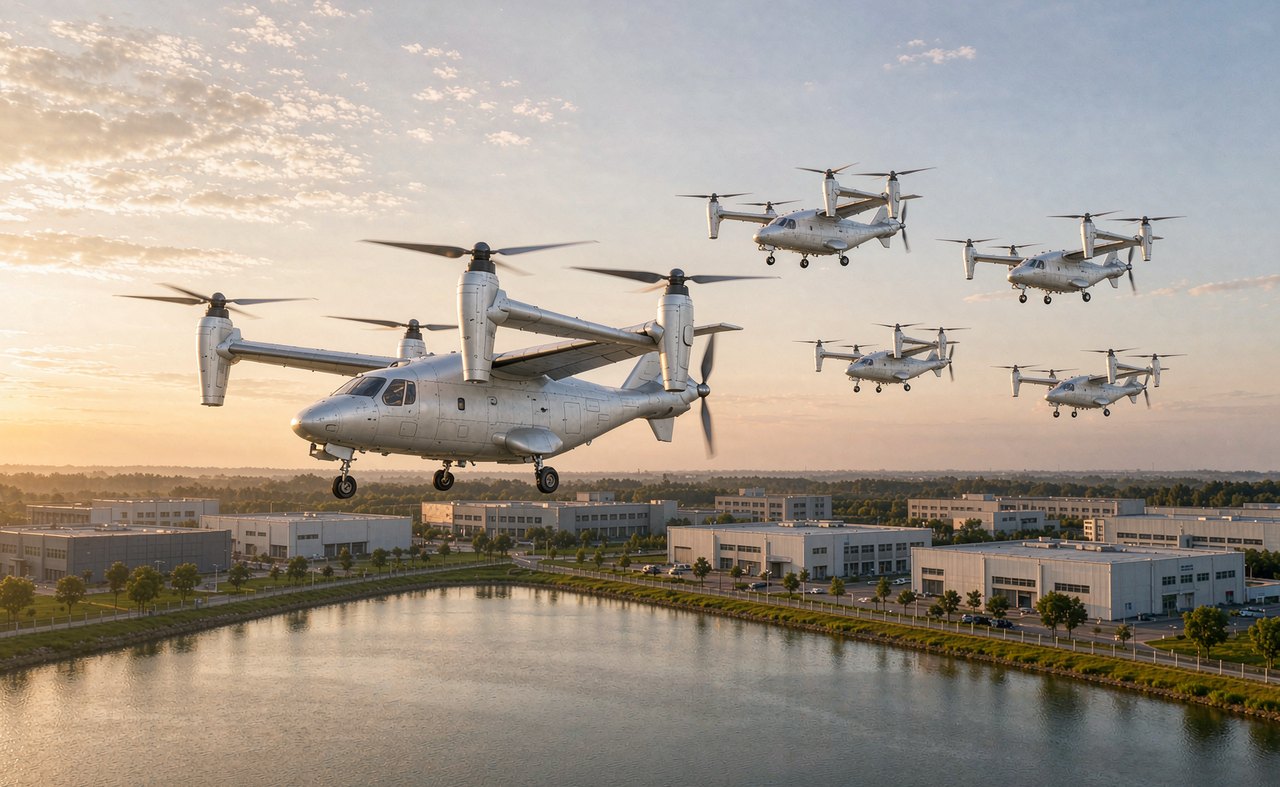
AutoFlight has released details of what it calls the world's first formation flight involving five unmanned eVTOL aircraft. The demonstrations took place on 31 October and 1 November at the company's Bailian Lake flight test base in Kunshan, China, and were announced on 5 November. The formation mixed three models and two weight classes: one five-tonne V5000 Matrix leading four two-tonne aircraft — the V2000CG CarryAll cargo variant, its V2000CGF firefighting sibling, and the V5000 line. According to the company, all five aircraft took off vertically, flew together for 47 minutes with the lead aircraft covering more than 133 kilometres, and did so autonomously, with no manual intervention. On 1 November the same formation held together in strong winds, maintaining what the company describes as safe horizontal and vertical separation. It follows a three-aircraft demonstration in May 2026.
The certification footnote matters as much as the flying: the V2000CG is the first ton-class eVTOL to hold all three airworthiness certificates from China's CAAC — type, production and airworthiness. The five-tonne V5000, by contrast, remains a demonstrator as far as public statements go.
Why this is a powertrain story
All of these aircraft share a lift-and-cruise layout: dedicated vertical-lift rotors get the machine airborne, then shut down completely once the wing is doing the work and a rear pusher propeller takes over. That architecture produces one of the harshest duty cycles in electric aviation. Lift rotors run at or near maximum thrust for a few minutes at zero airspeed — exactly when cooling airflow is weakest — then switch off. The pusher then holds a steady, comparatively low load for the rest of the flight.
Forty-seven minutes at cruise is long enough to expose any weakness in partial-throttle motor efficiency, ESC thermal margin, or propeller stiffness at the rpm where tip losses start to bite. Coordinated multi-aircraft flight adds a second requirement: when a five-tonne aircraft and a two-tonne aircraft share one route and one timing slot, thrust-to-weight margins across the fleet have to be predictable rather than best-case.
What the announcement does not say
There are no payload figures, no unit economics, no delivery schedule, and no detail on how much ground supervision the flights required. A company test base with invited guests is not a commercial route, and "world's first" is the company's own framing. Treat the milestone as evidence of technical capability, not of operational readiness.
The buyer's checklist
For anyone sourcing lift-and-cruise propulsion, the checklist is unglamorous. Ask for continuous rather than peak ratings at the ambient temperatures the aircraft will actually see. Require lift-chain redundancy that survives a single ESC failure. Demand transition data with the specified propeller fitted, not a bench substitute. And get pusher efficiency curves at 40-70% throttle, because that is where a lift-and-cruise aircraft spends most of its life. The formation flight makes a good headline; the procurement decision still comes down to what the motors do in minute thirty.
- LX-V804 MotorV-series lift motor for VTOL platforms
- LX-AT8025 Motor80-class AT pusher motor for the cruise phase
- LX-V40*16 PropellerVTOL propeller for lift-and-cruise aircraft
- LX-V200A 24S ESC24S high-voltage ESC with thermal headroom
Source: AeroTime (AutoFlight press release) — original report. This article is Aerotora's independent analysis, written for drone fleet operators and component buyers.
Aerotora specifies motor + ESC + propeller as tested sets under your own brand. MOQ 1 set, 72-hour dispatch on stock models.