4.2 Billion Mu a Year: China's Agri-Drone Fleet Reports Its Scorecard
At the 2026 China International Agricultural Machinery Exhibition, DJI Agriculture presented fleet-scale numbers for 2026: more than 4.2 billion mu of field operations, up 30% year on year — and a job list that goes far beyond spraying.
The Scale, in Plain Numbers
Speaking on the opening day of the exhibition — held in Tianjin on October 26-28 with nearly 300,000 square meters and over 3,000 exhibitors — DJI Agriculture said its fleet of 440,000 active agricultural drones logged more than 4.2 billion mu of operations in 2026 (mu is one-fifteenth of a hectare; roughly 280 million hectares counting repeat passes), a 30% increase over the same period last year.
The company also said it trained and certified 230,000 new pilots this year through a network of more than 1,400 training centers — a sign that the operator shortage long cited as the industry's main constraint is being addressed at fleet scale.
The Jobs List Keeps Widening
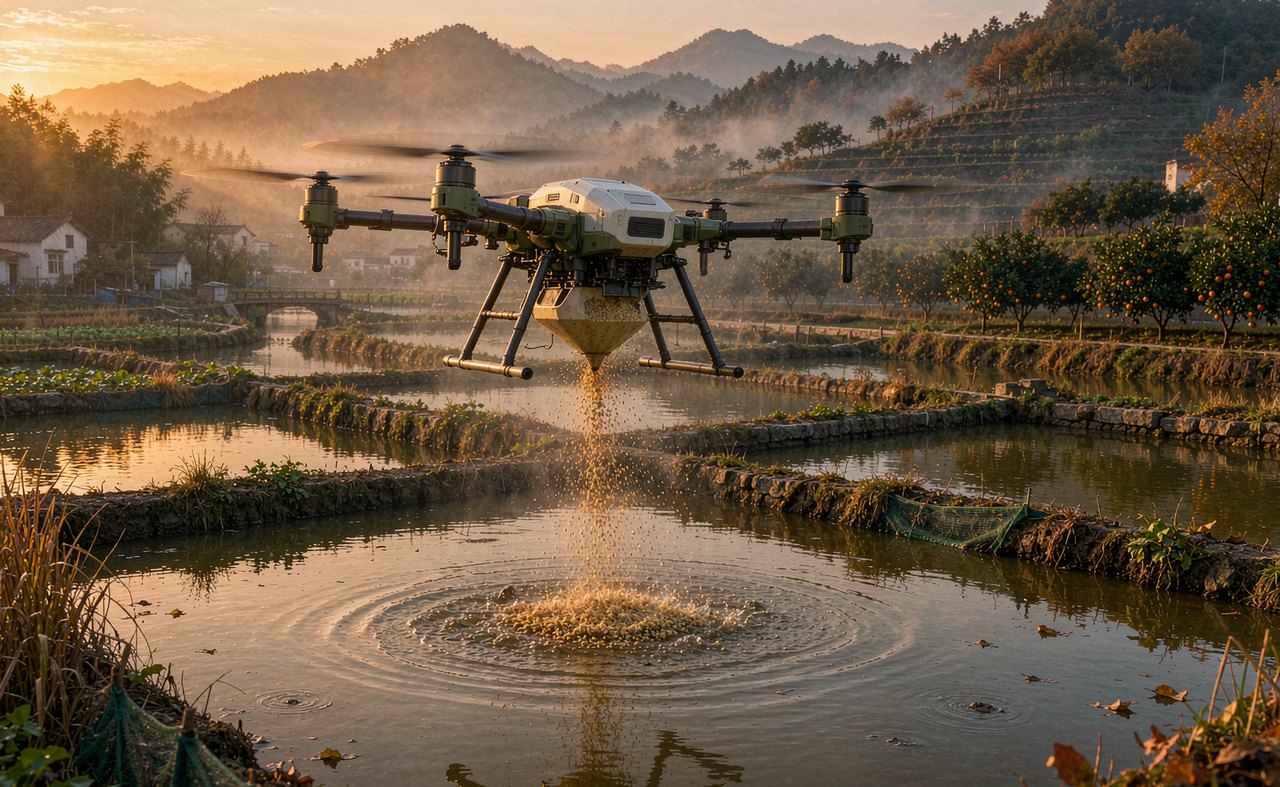
The most telling numbers sit in the use cases. In Jiangsu, drones now feed fish and crab ponds, spreading feed across 400 mu of water in as fast as one hour. In the hill country of Maoming and Meizhou in Guangdong, more than 300,000 tonnes of pomelos have been flown down from mountain orchards — the drone acting as a crane, not a sprayer.
In Heilongjiang's plains, field-management mechanization has climbed from under 12% to nearly 95% in ten years with drones in the mix. On the show floor, DJI displayed its T100S, T70S and T55 agri platforms alongside the FC200 cargo drone and a twin-auger spreading system — a portfolio pitched squarely at year-round, multi-task work.
What Fleet Buyers Should Read Into This
Three takeaways matter for operators and buyers elsewhere. First, utilization: fleets that once idled between spray windows are now booked across seasons — spreading one month, hauling the next — which changes the economics of ownership more than any single spec.
Second, duty cycles: hauling and feeding missions are hover- and climb-heavy, stressing powertrains differently from uniform spray passes. Arms, motors, ESCs and props sized for spraying alone will run hotter and age faster on mixed duty. Third, the pilot pipeline: 230,000 new certified operators a year means labor is ceasing to be the binding constraint.
Where to Look Next
For anyone spec'ing or reselling agricultural drone fleets, the message is to buy for the mission mix, not the mission. Check payload interchangeability (spray, spread, sling), thermal headroom for hover-heavy work, and matched propulsion sets rated for the heavier end of the duty cycle. China's 4.2-billion-mu scorecard is a market signal: the agri drone is becoming general-purpose farm infrastructure, and the propulsion behind it has to keep up.
- LX-P60-X Agri Motor ArmAgricultural power system for spray fleets
- LX-P80-X Agri Motor ArmHeavy-duty arm for spreading and haul missions
Source: Sina Finance — original report. This article is Aerotora's independent analysis, written for drone fleet operators and component buyers.
Aerotora specifies motor + ESC + propeller as tested sets under your own brand. MOQ 1 set, 72-hour dispatch on stock models.