Guangzhou Opens Its First Routine Drone Logistics Route: 51.5 km, 30 Minutes, 150 Parcels a Day
On October 23, Guangzhou's Nansha district launched the city's first regularly scheduled drone logistics route, moving parcels 51.5 km between a Panyu transfer hub and a rooftop hub on Lingshan Island in about 30 minutes — six flights and roughly 150 parcels a day.
What Actually Launched
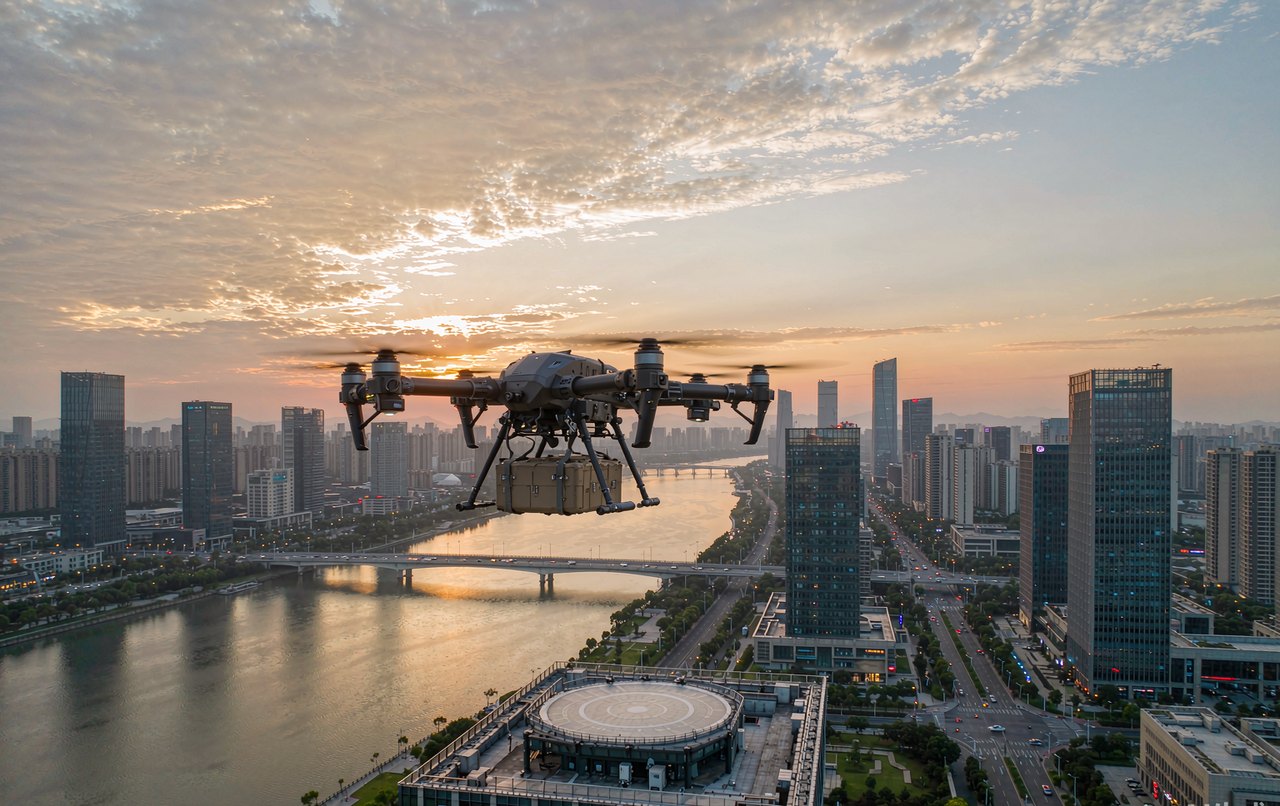
The route links a transfer station in Panyu's Hualong area with the IFC tower on Lingshan Island in Nansha's Hengli area. Three aircraft types are flying it: the ARK40 and ARK80 built by Yuexiu Intelligent Manufacturing, and Fengyi's FZ90, part of SF Express's cargo drone family. Maximum payload is 30 kg, true altitude is capped at 250 m, and the aircraft keep at least 80 m of clearance from obstacles along the corridor.
What lands on the roof does not stop there: an unmanned ground vehicle shuttles cargo from the landing site, and a building robot carries parcels the last flight of stairs. Operators say the drone leg turns a roughly one-hour drive into about 30 minutes of flight — and, more importantly, that operating cost is reportedly on par with traditional ground transport.
Cost Parity Is the Real Headline
Drone delivery demos are easy; drone delivery that pays for itself is not. Many early projects flew on subsidies and publicity budgets. The Nansha route's operators claim the opposite: on this 51.5 km corridor, flying parcels costs about the same as trucking them.
That claim, if it holds as flights scale up, changes how fleet buyers should read the news. Cost parity comes from unglamorous engineering: a fixed corridor flown every day, standardized aircraft and procedures, and enough daily utilization — six sorties, around 150 parcels — to amortize the fleet. None of that depends on a single heroic flight test.
What a 30 kg Multirotor Route Demands from Hardware
Aircraft in this class live a hard life. Six sorties a day, every day, means motors, ESCs and propellers spend far more hours under high load than a camera drone ever will. Hover-heavy flight profiles punish thermal margins: a power system that looks fine on a five-minute demo can cook itself on a long cargo run in summer humidity.
For manufacturers and integrators, that shifts procurement questions toward durability data — sustained thermal performance, insulation and bearing life under dust and moisture, vibration behavior with a swinging payload, and redundancy across arms and ESCs. Payload-carrying motor arms, in particular, become a sourcing decision in their own right rather than an accessory.
What to Watch Next
The operators have been explicit that this route is a starting point: medical sample transport, cross-border small parcels and port logistics are all named as candidate scenarios in the same district. For anyone building heavy multirotor platforms, the practical takeaway is to treat scheduled cargo routes like this one as the reference use case — spec your power systems for daily duty cycles, verify endurance with realistic payloads, and demand reliability numbers from component suppliers before a route like this puts your hardware in the air 300 days a year.
- Standard Motor ArmHeavy-lift motor arm for logistics and cargo multirotors
Source: NetEase (163.com) — SF Express & Yuexiu Nansha drone route launch, Oct 23, 2026 — original report. This article is Aerotora's independent analysis, written for drone fleet operators and component buyers.
Aerotora specifies motor + ESC + propeller as tested sets under your own brand. MOQ 1 set, 72-hour dispatch on stock models.