Two Tonnes Off the Line: China's Ton-Class Cargo Drone Enters Serial Production
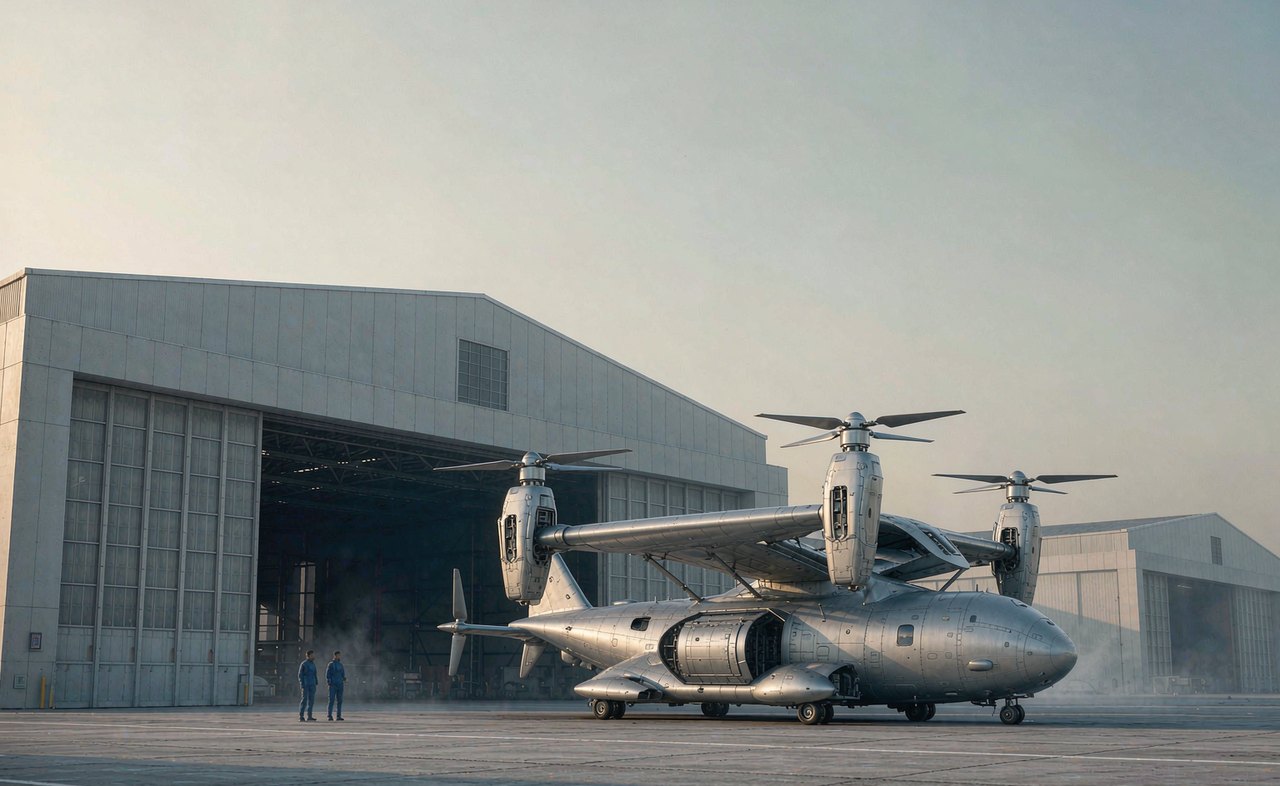
On 29 October, Shaanxi Huaying rolled the first series-production HE-1A out of its Weinan final-assembly base — a 4-tonne cargo UAV carrying 2 tonnes of freight. The airframe is the headline; the 110-aircraft order book behind it is the part propulsion buyers should read twice.
What actually happened in Weinan
The aircraft that came out of the hall on the morning of 29 October is not a one-off prototype: it is the first HE-1A built to a frozen design. Huaying's prototype flew in September 2024, and this machine marks the point where tooling, inspection procedures and supplier coordination were declared repeatable. The company says the Weinan plant covers 50,000 square metres with three production lines, and that at full ramp-up output would exceed 100 aircraft a year.
The commercial numbers are the unusual part for a ton-class unmanned freighter. Huaying reports 110 aircraft signed, a type certificate application accepted by the CAAC's Northwest Regional Administration in March 2026, and a RMB 530 million Series A round. The production aircraft is due to appear at the Zhuhai airshow in December and to fly before the end of the year; the company is targeting a type certificate by the end of 2027. None of that is a certificate in hand, so buyers should treat the schedule as a plan rather than a commitment.
Why 2 tonnes out of 4 is the engineering story
A payload fraction above 50 per cent on an unmanned freighter leaves very little room for everything else. Structure, avionics, landing gear and the entire propulsion chain — motors, ESCs, propellers, wiring — have to fit into the other half, together with fuel or batteries. Every kilogram spent on hardware is a kilogram of freight that cannot be sold, so on this class of aircraft the propulsion set is not a commodity line item. It is a direct input to the business model.
That changes how the specification is argued. Peak thrust on a test stand matters far less than continuous thrust at the altitude and temperature the route actually sees, and less than the efficiency of the whole motor-ESC-propeller combination at cruise. For a cargo operator, a two per cent gain in propulsive efficiency over a long sector is worth more than a headline number on a datasheet.
Two more airframes already in the queue
Huaying is not stopping at one platform. The HE-2 is described as a transport variant with a 5-tonne maximum take-off weight, 2 to 2.5 tonnes of payload and a rear-drop system for sites without a runway, with a first flight planned for 2027. The HE550 heads in a different direction: a compound-wing eVTOL in the 2-tonne class carrying at least 500 kg, using a hybrid oil-electric power system for vertical take-off and landing.
That last one is where the propulsion brief gets interesting for component suppliers. A lift-plus-cruise hybrid carries two jobs in one airframe: lift rotors that work hard for a few minutes, and a pusher unit that runs efficiently for hours, both fed from a hybrid power architecture. It is a different procurement problem from a pure multirotor, and it rewards suppliers who can document the matching, not just sell parts.
What buyers should do with this
For anyone sourcing propulsion for cargo or hybrid VTOL programmes, the practical lesson is to ask for matched sets with test data rather than individual components. Ask what continuous thrust is guaranteed at the density altitude of the intended route, how the ESC behaves under hybrid or regenerative bus conditions, and what the spare-parts lead time looks like once a fleet is in service.
The HE-1A itself is a Chinese domestic programme with a domestic supply chain. But the class of aircraft it represents — tonne-level unmanned freight with a real order book — is exactly where motor, ESC and propeller demand will concentrate over the next few years. Serial production is the moment when component decisions get locked in, usually for the life of the type.
- LX-XU8XXL-X Heavy-Lift Motor ArmHeavy-lift multirotor arm for cargo platforms
- VTOL & Special Application MotorsLift and pusher motors for hybrid VTOL platforms
- LX-V200A 24S High-Voltage ESC24S high-voltage ESC for large platforms
Source: CNR News via Tencent News — original report. This article is Aerotora's independent analysis, written for drone fleet operators and component buyers.
Aerotora specifies motor + ESC + propeller as tested sets under your own brand. MOQ 1 set, 72-hour dispatch on stock models.