Hydrogen at -30: Northeast China's First Fuel-Cell Drone Flight Comes With a Factory Attached
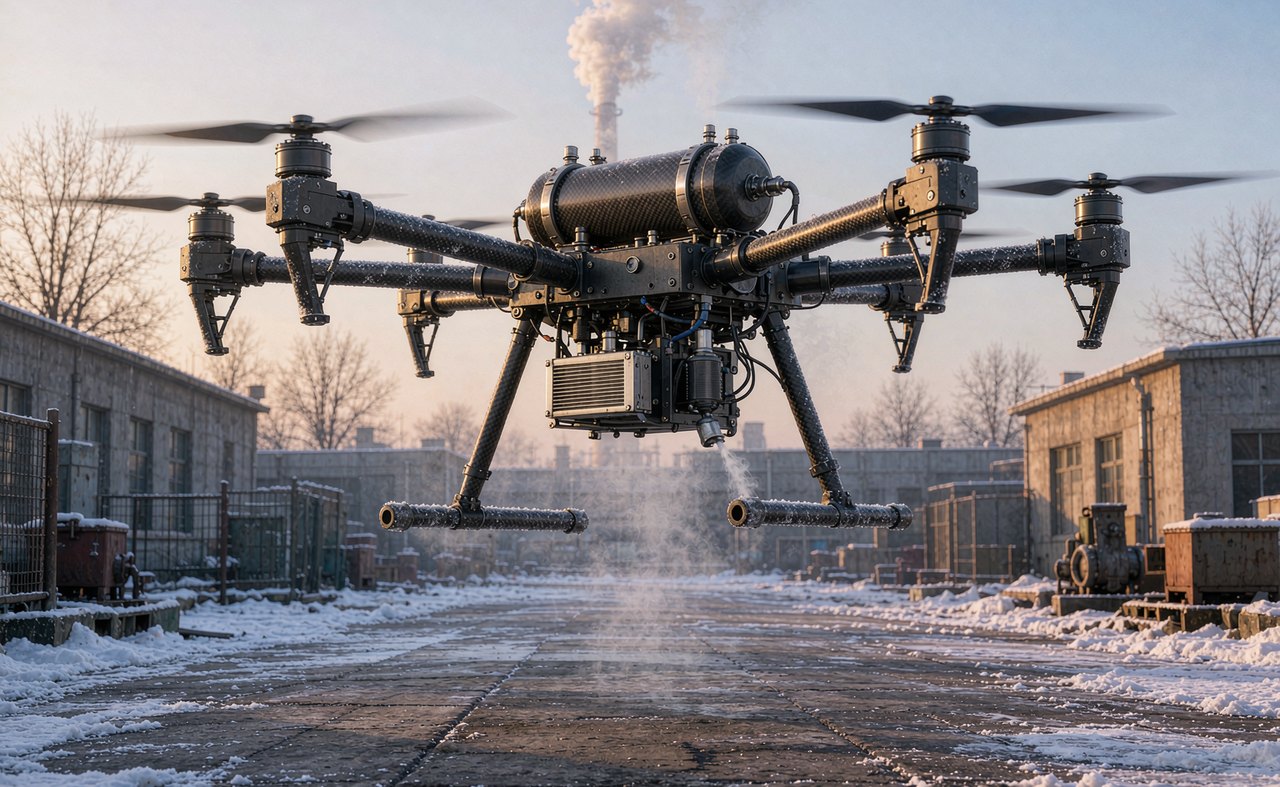
Northeast China's first hydrogen fuel-cell drone flew this week in Mudanjiang, Heilongjiang — and the province's first hydrogen drone assembly line switched on the same day. Two events, one signal worth reading for anyone sourcing long-endurance powertrains.
One flight, one factory
Per a November 3 report by Heilongjiang News Network, a hydrogen fuel-cell drone completed the first flight of its kind in Northeast China at the machinery and electronics industrial park inside Mudanjiang's Industrial Collaboration Park. On the same day, the Xieqing Ruifei Mudanjiang base — Heilongjiang's first hydrogen drone assembly line — was officially commissioned: a RMB 200 million facility signed in January 2026 with Xieqing (Shanghai) New Energy Technology and built out in under a year.
On-site observers noted the aircraft hovered for what looked like "over an hour." Neither the company nor the report published formal endurance, payload or temperature specs, so treat the anecdote as color, not data. What is verifiable is the industrial footprint: phase one holds three lines — 100,000 square meters of carbon paper per year, 5,000 fuel-cell stacks per year, and a 3,000-unit annual drone assembly capacity on an 80-meter loop line.
Why cold is the hard part
Cold is where electric drones bleed range fastest. Batteries lose usable capacity at low temperature, and PEM fuel cells are notoriously reluctant to start below freezing without preheating. Any operator running winter inspection, border patrol or emergency logistics in northern China knows the gap between lab endurance and January endurance.
That is exactly the problem this base is aiming at. It says its drones carry what it describes as the world's first heat-recycling system for extreme-cold drone operation, pairing hydrogen propulsion with cold-climate engineering. Independent verification will take time, but the targeting is smart: instead of building a general-purpose aircraft and hoping it survives winter, the site's entire development anchor is sub-zero performance.
Vertical integration, not just assembly
The more durable story is the supply chain. The base runs carbon paper production — the gas-diffusion backbone of a fuel cell — feeding its own stack line, which feeds its own aircraft assembly. That closes the loop from upstream material to flyable drone inside one campus. The stack line is already ramping small air-cooled stacks for cold regions, with orders reportedly booked through year-end. Phase two adds a 3,000-unit-per-year drone control system line and a low-altitude R&D center, with expected annual output of RMB 150 million once it starts and RMB 420 million at full ramp.
What it means for powertrain buyers
For integrators and fleet buyers, hydrogen changes the sizing math. A fuel cell delivers steady cruise power but cannot spike; real systems pair the stack with a buffer battery that handles takeoff and burst loads. That means motors and arms should be selected for cruise-point efficiency rather than peak efficiency, and ESCs need enough thermal headroom for battery-assisted surges.
It also changes logistics: refueling a pressure bottle takes minutes, but hydrogen supply and cylinder certification become part of your operating plan. For missions under 20 minutes, batteries still win on simplicity — hydrogen earns its keep on long hover, patrol and ferry tasks.
What to watch
No published performance data and no named customers yet — the honest read is that this is a manufacturing milestone, not a proven product. Watch for verified winter endurance figures, the first municipal or utility contracts in cold regions, and whether the carbon-paper-to-stack-to-aircraft model holds up at volume. If it does, Northeast China — a region that spends much of the year below freezing — becomes the natural testbed for hydrogen drones, and a template other cold-climate markets will copy.
- Standard Motor Arms (LX-XU8XXL-X)Heavy-lift multirotor arms for long-endurance platforms
- LX-V200A 24S ESCHigh-voltage ESC with thermal headroom for buffer-battery surges
- LX-AT8025 pusher motorEfficient cruise propulsion for hybrid fixed-wing VTOL
Source: Heilongjiang News Network (黑龙江新闻网) — original report. This article is Aerotora's independent analysis, written for drone fleet operators and component buyers.
Aerotora specifies motor + ESC + propeller as tested sets under your own brand. MOQ 1 set, 72-hour dispatch on stock models.