From Spraying to Hauling: Orchard Drones Now Ferry 100 kg of Fruit per Trip
In hillside orchards across Sichuan and Guangdong, agricultural drones have picked up a second job: ferrying harvested fruit down steep slopes that pickers once carried on their backs.
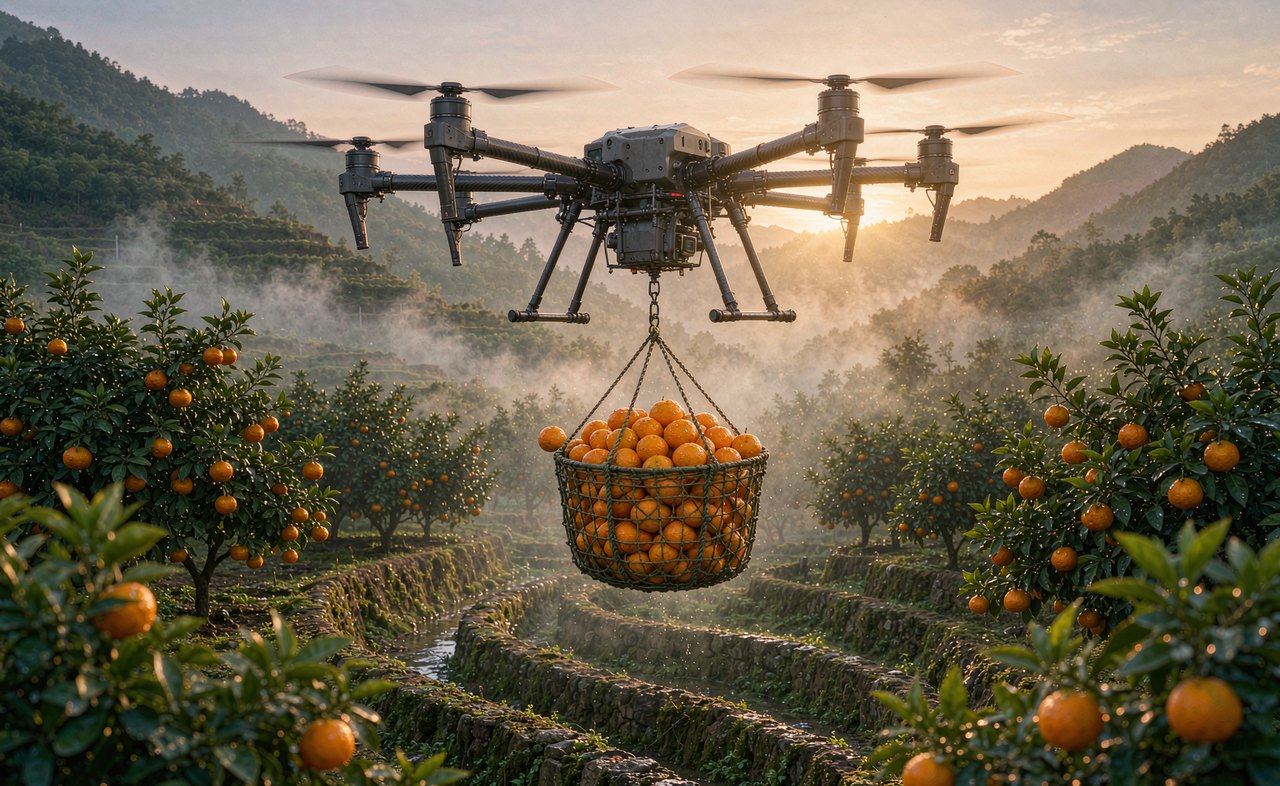
A new job for the farm drone
Reporting from Cover News this week describes the scene in Huili, Sichuan, where the pomegranate harvest is in full swing. A worker hauling a basket of about 45 kg of fruit downhill used to spend more than 20 minutes per trip; now a local operator flies the same stretch with loads of around 100 kg, delivered to the loading point at the foot of the hill in well under a minute.
In Ziyang, also in Sichuan, early-mandarin growers in Yanjiang district are running the same playbook, with single trips carrying up to 100 kg of fruit to sorting stations. The district has organized a local crop-protection drone alliance — dozens of licensed pilots and more than 100 aircraft — so orchards can book lifting services the way they book spraying.
Policy is following practice: in April, Sichuan's agriculture department issued a notice that explicitly encourages using drones to move fresh fruit from hillside orchards to collection points, alongside continued research into the technique.
Meizhou shows what scale looks like
The strongest evidence comes from Meizhou in Guangdong, a major pomelo region. An estimated 150,000 to 175,000 tonnes of pomelos — close to half of the region's total output — were ferried out of orchards by drone in 2025, according to local estimates cited in the report.
The economics are easy to picture: on a typical 200-meter run, two crew members move one load in about a minute, and a single aircraft can lift as much as 30 tonnes of fruit in a day. One young pilot who returned from a data-analytics job to fly for the harvest moved roughly 3.5 tonnes of pomelo in about 90 minutes using a DJI T100.
The shift has moved fast enough that DJI's agriculture unit and industry partners have published consecutive annual white papers covering safe operating practices for transport work, not just spraying.
Hauling is not spraying
Moving cargo changes the flight envelope. Slung loads swing and shift the center of gravity; mountain terrain produces gusty, unpredictable wind near ridgelines; orchard slopes are cluttered with power lines, branches and people.
That is why industry voices in the report stress standards and training alongside hardware: ground-crew coordination, on-site risk assessment and pilot skill now matter as much as raw lift capacity. An aircraft that is overpowered on paper can still be the wrong tool if the crew has not rehearsed sling operations in confined terrain.
What integrators should take away
For fleet operators and OEM buyers, the lesson is that 'agricultural drone' is no longer a synonym for 'sprayer'. Transport missions reward power systems sized with real hover margin, because a 100 kg sling load leaves no room for an underpowered motor arm or an ESC running at its ceiling.
If you are speccing machines for orchard or mountain work, ask suppliers for hover-thrust data measured with the actual cargo weight attached — not just free-air bench numbers — and match the motor arm, motor, ESC and propeller as a set. The orchards doing this today chose hardware that survives daily max-load cycles; that is the benchmark worth buying against.
- P60 Agricultural Motor ArmPower arm for agricultural spraying and lifting platforms
- P80 Agricultural Motor ArmHeavy-duty power arm for large agri drones
Source: Cover News — original report. This article is Aerotora's independent analysis, written for drone fleet operators and component buyers.
Aerotora specifies motor + ESC + propeller as tested sets under your own brand. MOQ 1 set, 72-hour dispatch on stock models.