The Operator Shortage, Not the Drone, Is the Real Bottleneck in Farm Automation
XAG, the world's second-largest agricultural drone maker by revenue, told the Financial Times it wants every farmer to own a robot — and argues that a shortage of trained operators, not hardware, will decide how fast farm automation spreads.
The bottleneck is people, not aircraft
Agricultural drones have largely solved the engineering problem: modern spray platforms fly, sense obstacles and cover fields reliably. What they have not solved is who flies them. Speaking to the Financial Times, XAG senior vice president Gong Jiaqin argued that trained operators are now the biggest constraint on the industry. Pilots tend to rush one field to reach the next, and remote farms often cannot attract an operator at all.
The demographic math behind that claim is stark. XAG estimates about 12 million people leave China's countryside for cities every year, and the farming population keeps aging. In the company's own projection, China will need roughly 3 million agricultural drones within three years — and up to 12 million if every tract of the country's farmland were to be covered.
Automating everything except the flying
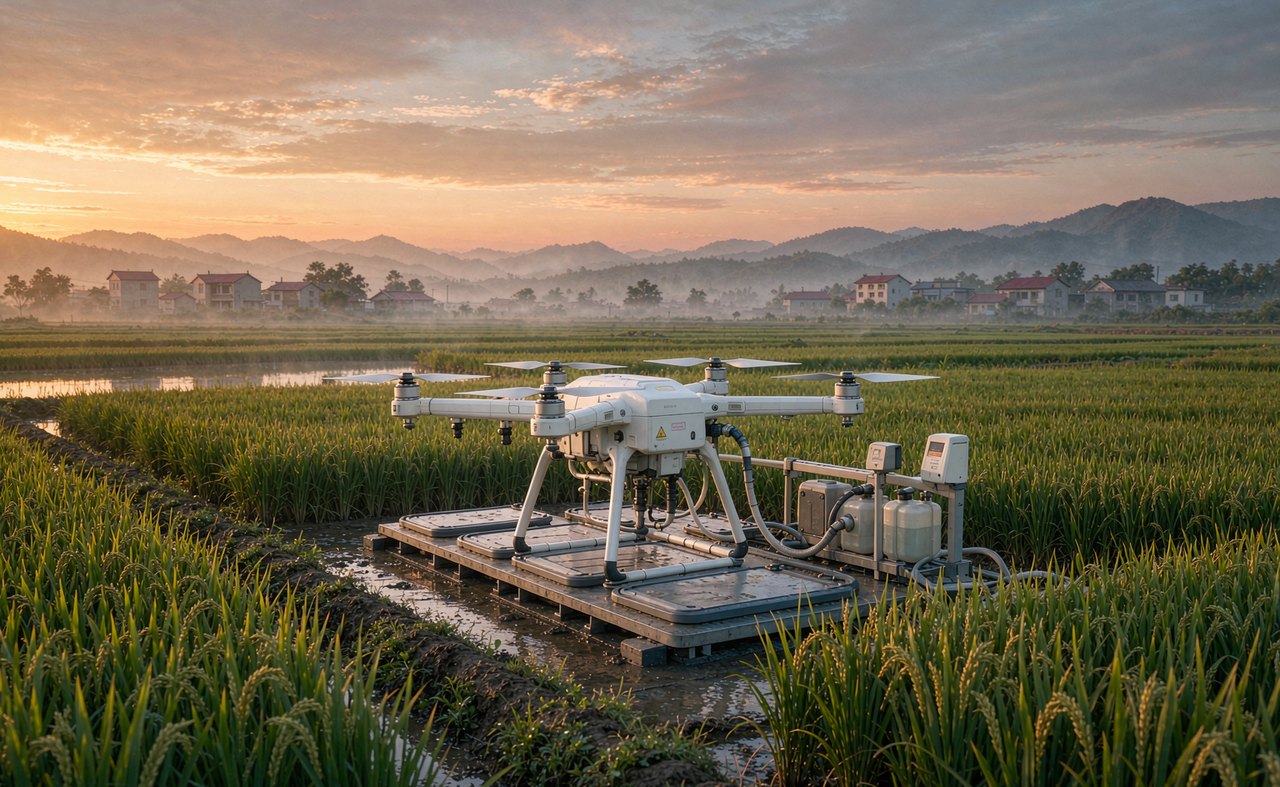
XAG's answer to the labor gap is to take people out of the loop entirely. The company has built a system of docking stations that automatically clean, recharge and refill the drone after each sortie, while flight routes are planned by software rather than a pilot on the ground. The pitch is simple: a drone should stop being a contracted service you hire and become a tool the farmer owns — closer to a tractor than to a charter flight.
That framing is a deliberate split from the fleet-service model that dominates today's market, where specialized operators run large numbers of aircraft for many clients. If individual ownership becomes the default, the buyer base for agricultural drones could widen from a few thousand service companies to millions of farm businesses.
A market map reshaped by restrictions
The FT report also sketches how geopolitics is redrawing XAG's customer map. The company sells drones, ground robots and field sensors to nearly 70 countries. The United States, once its largest overseas market, has fallen to second place after strict limits on sales of new Chinese drones; Brazil now ranks first. XAG recently obtained approval to sell its latest models in the US, but Gong expects that market to stay difficult.
Financially, the company is preparing a Hong Kong listing. SoftBank holds a 12.9% stake, and XAG's 2023 funding round valued it at about 1.5 billion US dollars.
What it means for component buyers
If farm-owned drones replace centralized fleets, the parts business changes shape. Instead of a few large operators with in-house technicians, demand comes from thousands of small owners who need spare parts fast, simple diagnostics and modular components they can swap in the field. For power-system suppliers, that favors standardized, field-serviceable motor arms, motors and ESCs over sealed proprietary assemblies.
Buyers evaluating agricultural platforms this season should ask one more question alongside flight performance: how long is the spare-parts lead time, and can a failed arm, motor or ESC be replaced locally without sending the whole aircraft away? The answer may matter more than the spec sheet in a market moving toward owner-operated machines.
- P60 Agricultural Motor ArmField-serviceable 28in power arm for spray drones
- P80 Agricultural Motor ArmHeavy-duty arm for 30L+ agricultural platforms
Source: Financial Times (via Sina Finance) — original report. This article is Aerotora's independent analysis, written for drone fleet operators and component buyers.
Aerotora specifies motor + ESC + propeller as tested sets under your own brand. MOQ 1 set, 72-hour dispatch on stock models.